 Switzerland
  Poland
 Czech Republic
  Germany

 Spain
Spain Where cider begins
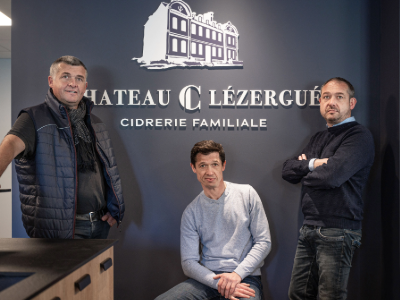
Amid the apple orchards and crêperies of Finistère in Brittany, a small family venture has grown into a cidery producing around five million bottles a year. Today, three brothers run Château Lézergué in distinct roles, united by one conviction: to make good cider, everything has to be done right straight from the pressing stage. This is a story of family and growth, of people who stay, of old machines and a new generation of technology.

By lunchtime, cider is already on the table
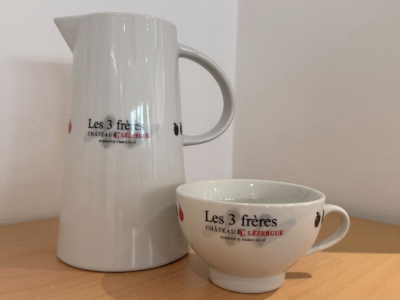
In Brittany's crêperies, cider is a natural accompaniment to a meal, often served in traditional ‘bolées’, the thick-walled ceramic cups that are as much a part of the scene as galettes and crêpes. For visitors, this is part of the Breton way of life. For Guillaume Jan, it is also a familiar part of the cider market, one he has known for many years.
‘Tourists who come to Brittany go to crêperies,’ he says. Very little beer or wine is ordered there. Cider, by contrast, simply belongs. Château Lézergué supplies it not only in bottles but also in kegs, a format increasingly in demand among crêperies.
A few kilometres away begins the story behind that glass – or rather, behind that cup.
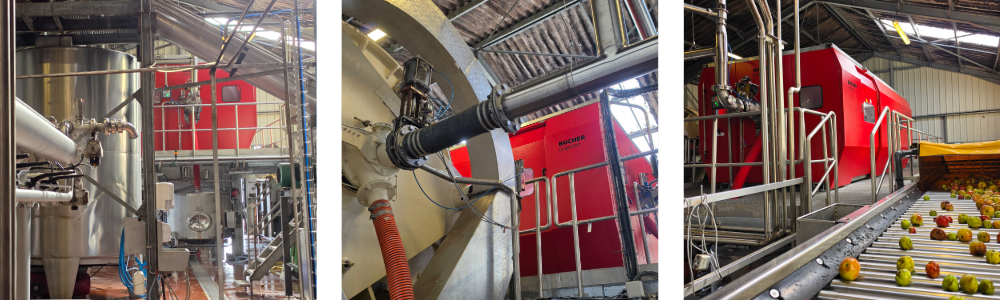
Around the cidery at Ergué-Gabéric in Finistère lie the Jan family's orchards. During the harvest, cider apples wait to be processed. Ripe, some of them already very ripe, the fruit defines both the look and the scent of the site for a few weeks each year. Outside, the trees and the harvest. Inside, stainless steel, pipework, tanks, pumps – and presses from different generations.
The contrast could hardly be greater.
And yet none of it feels contradictory.
Because the story of Château Lézergué is not one of a traditional craft eventually displaced by modern technology. It is a story of the two evolving together.
It all begins with trees
In 1990, there is no cidery in the sense that exists today.
Guillaume's father and his eldest brother, Matthieu, begin planting apple trees and establishing the orchards. At first, the aim is not even to make cider themselves. The family wants to grow cider apples.
Five years later, Guillaume joins the business.
And with him, the idea changes.
Why sell the fruit? Why not process it themselves?
The family sets up a small production area. Their own apples become the first cuvées. Guillaume takes on whatever a young family business demands: working in production, selling, finding customers. He goes to markets and visits restaurants and crêperies in the surrounding area.
In 1995, they produce around 2,000 bottles.
Five years later, that figure has already reached 100,000.
When Joseph joins in 2000, the business has grown to the point where Guillaume can no longer manage production and sales at the same time. Joseph increasingly takes charge of production. Today, he is Château Lézergué's maître de chai, its cellar master: responsible for the recipes and for turning the juice into the ciders for which the house is known.
The roles of the three brothers were not decided in a strategy meeting. They emerged from the history of the business itself.
Matthieu remains the man of the orchards. Together with three employees, he looks after the family's 42 hectares of orchards, the trees and the annual harvest.
Joseph, as maître de chai, is responsible for cider production.
Guillaume works where the different strands come together: sales, staff, investment, management – and, when necessary, a little bookkeeping too.
He explains why this division of roles works with a certain humour. Matthieu likes spending his days outside in the orchards; negotiations with banks would probably hold rather less appeal for him. Guillaume, for his part, cannot quite imagine spending an entire winter among the trees in the rain and cold.
In the end, he suggests, each of them has probably ended up more or less exactly where he belongs.
Even the three brothers' mother is still part of the business.
To this day, she keeps the books.
The people behind the product
When Guillaume is asked what sets Château Lézergué apart, he starts with the family.
But he does not stop there.
Almost in the same breath, he talks about the employees.
People who join the business tend to stay, he says. Staff turnover is very low. And when people stay, their knowledge stays with the business too.
At first, that may sound like a minor aside in a family story. In fact, Guillaume is touching on one of the fundamentals of craft production: experience cannot simply be replaced. Spend years working with the same fruit, the same machinery and the same processes, and you learn to recognise changes before they show up in a metric. Knowledge is not only documented. It accumulates in people.
For Guillaume, that continuity is part of the quality of the product.
By now, however, Château Lézergué is a long way from being a small farm operation.
The family's 42 hectares of orchards are farmed entirely organically. Depending on the weather, they produce roughly 500 to 900 tonnes of apples a year. The variation is considerable – ‘nature is what it is’, as Guillaume puts it.
In total, the cidery now processes around 5,600 tonnes of apples a year. The majority is therefore bought in from other growers. Depending on the product required, organically or conventionally grown apples are used.
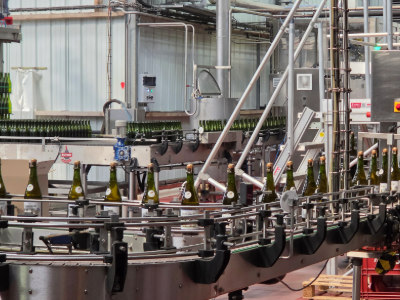
Château Lézergué produces around five million bottles a year. And then there is the cider sold in kegs.
From the 2,000 bottles of 1995 to where it stands today, a business has grown whose roots are still visible from the production windows.
And perhaps that is precisely why Guillaume speaks of no stage in production with as much emphasis as the moment when juice is first extracted from those apples.
The point where everything is decided
‘Le métier de cidrier démarre au pressage.’
‘The cider maker's craft begins with pressing.’
Guillaume does not say it in passing. He returns to the thought again and again during the conversation.
For him, the press is not simply another machine at the beginning of a production line. Pressing is the process stage at which a substantial part of the economic outcome is already decided.
Every extra point of yield, he says, is extra margin.
Behind the rather dry term ‘yield’ lies a very simple logic: any juice left behind in the fruit at pressing can never become cider. The fruit may be excellent and the cellar work impeccable – juice lost at this stage is lost for good.
At Château Lézergué, that logic is concentrated into roughly ten weeks of the year.
That is how long the pressing campaign lasts.
During those weeks, Guillaume follows the yields every day. If the figures start moving in the wrong direction, he wants to know why.
His comparison with bottling makes clear why the subject matters so much to him. If a machine fails there and production time is lost, the work can be caught up later.
During the apple campaign, that equation no longer works.
The raw material will not wait.
‘If I don't press properly during the campaign,’ Guillaume says in essence, ‘afterwards it's too late. I can't get it back.’
That is why the history of the presses at Château Lézergué is also a history of the development of the business itself.
From straw to hydraulics
In the early years, the family still works with what are known as pack presses.
Guillaume describes the principle today almost with a smile: a layer of crushed apples, a layer of straw – apple, straw, apple, straw.
Belt presses follow later.
As the cidery grows, however, it becomes increasingly clear that yield is becoming the decisive criterion for the family. As processing volumes rise, any juice left in the pomace matters economically too.
In 2012, Château Lézergué decides to draw a line under that chapter.
Guillaume sums up the mood at the time with a simple ‘Stop’. There were now a great many apples to process, and when it came to pressing, it was time to ‘get serious’.
The family opts for hydraulic pressing technology from Bucher Unipektin.
First comes an HP 3000. When that too no longer has enough capacity, an HP 5000 follows.
Guillaume recalls that at one point he was even offered a decommissioned belt press almost free of charge. He declines. If the other cidery had already replaced its belt press with Bucher presses, he reasoned, he did not want to put it back into service at his own site.
Instead, he goes looking for an HP 5000.
The presses thus become markers in Château Lézergué's growth story.
One machine tells that story particularly vividly.
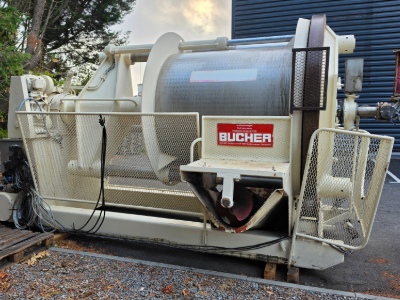
The HP 3000, which eventually became too small for the business, dates from 1978.
Almost half a century after it was made, it still works.
Guillaume states the fact without any drama. It was replaced because something larger was needed.
‘Elle marche très bien.’
‘It works very well.’
Today, the retired press stands in the yard at Château Lézergué. It left production not because its technical life had come to an end, but because the business needed more capacity.
The business had simply outgrown it.
Not new for the sake of being new
When more capacity is needed once again, an obvious solution presents itself: another used HP 5000.
Château Lézergué considers the option.
But this time, more is at stake than the next increase in capacity. The family now sees the press installation as part of a medium- and long-term industrial project.
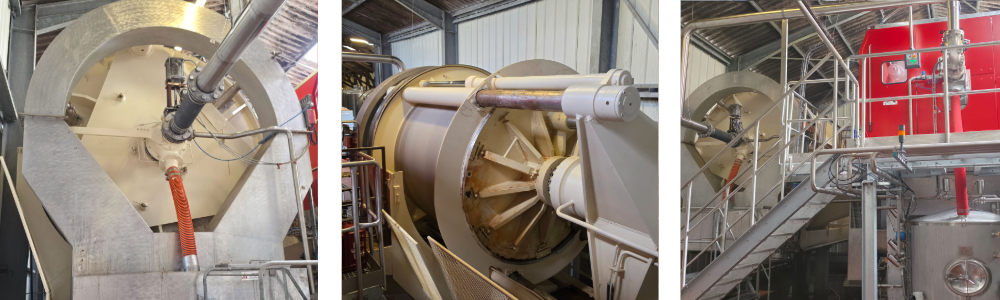
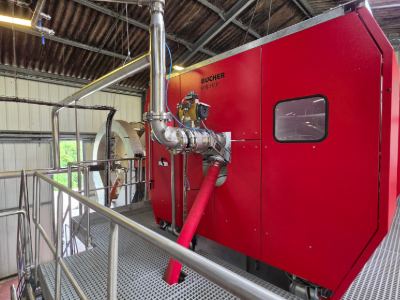
They therefore opt for a new HPX 6007 from Bucher Unipektin.
Anyone expecting Guillaume to talk first about digitalisation or automation would be wrong.
He sums up his most important criterion in a single sentence:
‘La priorité, c'est les rendements.’
‘The priority is yield.’
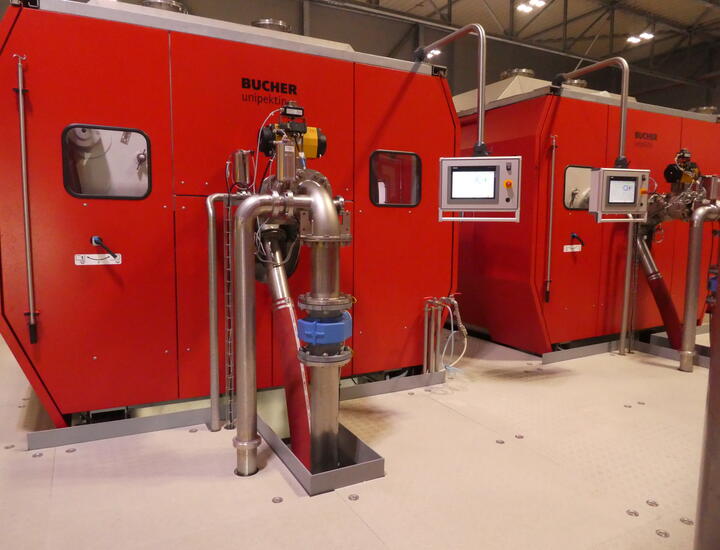
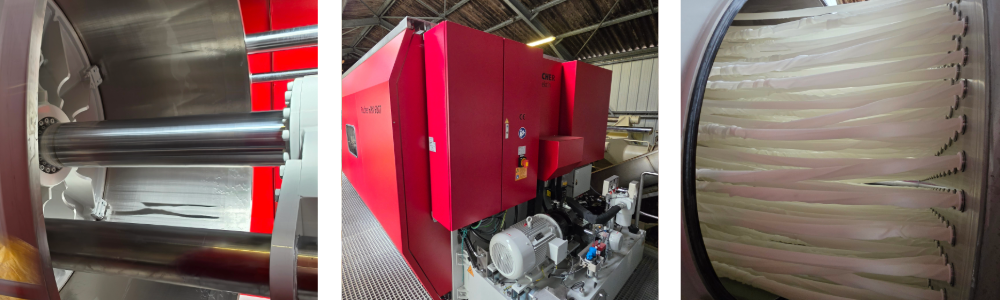
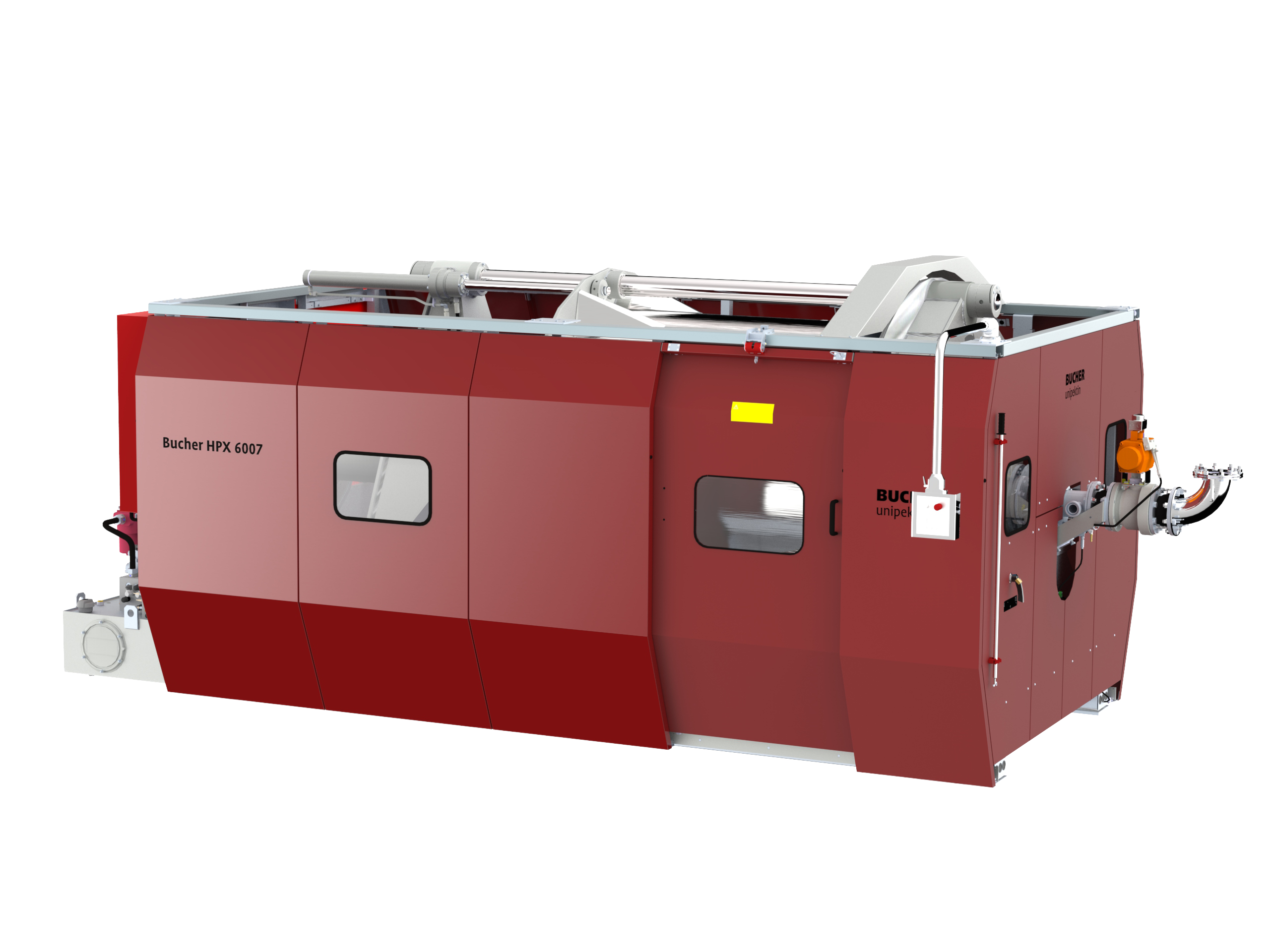
At its heart, the HPX 6007 is a hydraulic piston-cylinder system. Its 120 flexible drainage elements carry the juice out of the press chamber. As the piston advances, the apple mash is pressed. On the return stroke, simultaneous rotation of the press unit loosens the press cake and prepares it for the next pressing step. Pressing and loosening alternate repeatedly until the desired result is achieved.
But the mechanics are only part of the equation. The self-optimising control system continuously assesses the pressability of the product and adjusts the relevant process parameters accordingly. At the same time, process and production data are recorded in real time.
This is where the technology meets what Guillaume means when he talks about yield. For him, automation is not an end in itself. It makes it possible to carry out the necessary pressing and loosening steps consistently and repeatably, while adapting the process to the behaviour of the apple mash being processed.
For Château Lézergué, the real advance therefore lies not simply in reducing the amount of work done by hand.
It lies in enabling the process to do, more consistently, exactly what Guillaume expects of it: extract as much juice as possible from the apples.
He even builds the investment case around precisely that effect. Higher yields, he says, will pay for the press.
Technology is thus given a very concrete task.
Its job is to make the most efficient possible use of a valuable agricultural raw material.
The roof is more nerve-racking than the commissioning
The decision to invest in the new press comes with a demanding timetable.
The order is signed in early February. By the end of August, the installation has to be ready.
In between, simply delivering the machine is only part of the job.
Part of the building has to be opened up so that cranes can lift the press into position. Its dimensions give some idea of the logistical challenge: the HPX 6007 is around 7.25 metres long and weighs approximately 18 tonnes when empty.
The water, compressed-air and electrical services all have to be adapted. Plant engineers, welders and electricians work under considerable time pressure.
For Guillaume, this is the nerve-racking phase of the project.
Not the commissioning itself.
Asked whether he felt tense before commissioning began, his answer is surprisingly relaxed.
Not really.
When the press leaves Bucher Unipektin's factory in Switzerland and is loaded onto the lorry, he says in essence, he assumes it will work.
He was far more concerned about whether everything around the machine would be finished on time.
It is a telling comment on a long-standing supplier relationship, even though Guillaume does not present it as one.
Trust sometimes reveals itself most clearly in the things that no longer make you nervous
Several generations, one story
The HP 5000 remains part of that story too.
Its performance remains good, Guillaume says. With proper maintenance, he sees no reason why it should not continue to run.
His verdict could scarcely be shorter:
‘C'est très robuste.’
‘Very robust.’
For him, the limiting factor today is not the machine's mechanical performance, but its level of automation.
Looking to the future therefore does not necessarily mean another new press.
Instead, Guillaume can imagine automating the HP 5000 as part of a retrofit. He mentions 2027 as a possible target.
Today, three generations of presses tell different chapters in the development of Château Lézergué.
Out in the yard stands the retired HP 3000 from 1978 – still fully operational.
In production, the HP 5000 continues to work. The family remains convinced by its mechanical performance, which is why automation rather than replacement is conceivable as the next step.
And with the fully automated HPX 6007, the next chapter has already begun.
That contrast says a great deal about the development of Château Lézergué: one press leaves production not because it has reached the end of its service life, but because the business needs more capacity. A second remains in service and may yet be automated. And a new one takes on the demands of the next phase of development.
Tradition and modern technology are not opposing forces here.
They are stages of the same story.
An investment in ten decisive weeks
This is no small step.
‘Ce n'est pas rien,’ Guillaume says of the project.
‘That's no small thing.’
According to Guillaume, the new press and its associated equipment represent Château Lézergué's largest investment over the past five years – even though the business has also invested in bottling and infrastructure during that period.
For Guillaume, giving the press this level of priority is entirely logical.
A cider maker presses apples, he says. If you are not prepared to commit the necessary resources at that point, you have to ask whether you have chosen the right profession.
The family's decision to choose Bucher Unipektin again, he says, came down to no single factor.
He cites yield. The robustness of the machines. Their experience with Bucher Unipektin. The service. And together, these provide something of considerable value during a ten-week harvest campaign: peace of mind.
The press has to work. It has to keep working over the long term. And if a problem arises, it has to be possible to resolve it.
It sounds less like enthusiasm for machinery and more like the perspective of an entrepreneur who knows just how short his decisive window is each year.
Perhaps that is precisely why different generations of technology fit so naturally into a single story at Château Lézergué.
A machine's age does not determine its value.
What matters is whether it does its job.
The scale has changed. The beginning has not.
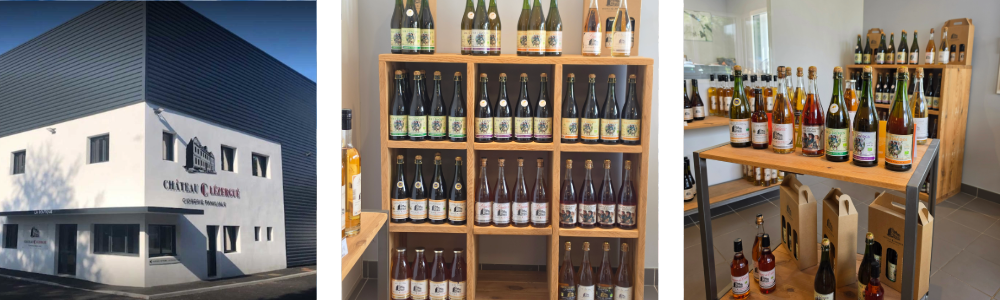
Later, the cider is back where this story began: on a table in Brittany.
For a guest in a crêperie, it may simply be a drink that belongs to this place. A taste associated with holidays, galettes and Brittany.
Behind it, however, lie more than three decades of family history.
A father and son who began by planting apple trees. A second son who, in 1995, wanted to turn the fruit into cider himself. 2,000 bottles. Then 100,000. A third brother who became maître de chai. Employees who stayed, and their knowledge with them. Forty-two hectares of the family's own orchards. Today, around five million bottles a year. Old presses that became too small for the business before they reached the end of their service lives. And now a new installation for the next phase of development.
Château Lézergué has grown in many ways.
More professional. More automated. More productive.
But at heart, the route to cider has remained the same.
From tree to fruit. From fruit to juice. From juice to the cellar. And eventually, from there to the table.
The scale has changed.
The beginning has not.
How the HPX 6007 works
The HPX 6007 operates with a hydraulic piston-cylinder system. Its 120 flexible drainage elements carry the juice out of the press chamber. Pressing and loosening alternate repeatedly until the desired pressing result is achieved. The self-optimising control system continuously adjusts the relevant process parameters and records process and production data in real time.
In brief:
- hydraulic piston-cylinder system
- 120 flexible drainage elements
- repeated pressing and loosening steps
- self-optimising process control
- real-time recording of process and production data